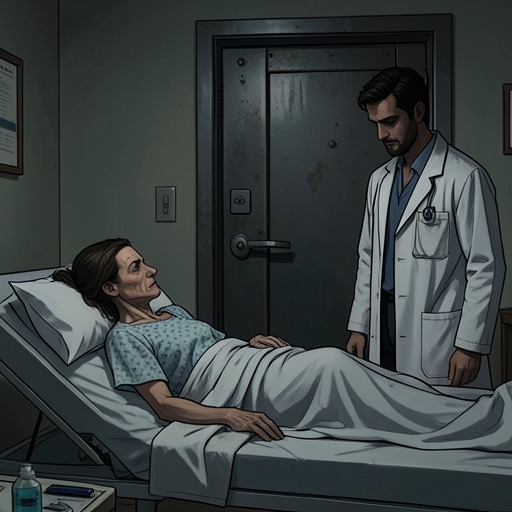
Kate Ryan’s inflammatory breast cancer
Firefly LaneKate Ryan’s inflammatory breast cancer is a fast-moving illness whose course exposes the limits of reassuring tests and aggressive treatment. A recurring skin change that Kate had understood as an infection leads to an urgent ultrasound and biopsy; the diagnosis is advanced and has already spread. Surgery, chemotherapy, and radiation fail to stop the disease. When it reaches Kate’s brain and causes a stroke, she refuses further treatment and asks the people she loves to stay with her. The cancer’s arc is therefore both medical and relational: it transforms the ordinary work of diagnosis into a crisis of uncertainty, separation, reconciliation, and care.
Symptoms, Examination, and Diagnosis
At a routine appointment, Kate’s examination proceeds through the familiar formalities of women’s health care before the doctor stops chatting and asks about a discolored patch on her right breast. The area, beneath the nipple, is about the size of a quarter; Kate describes slightly puckered skin and says the problem has come and gone for roughly nine months to a year. She had first thought it was a bug bite, and her family doctor had treated it as an infection with antibiotics. It had temporarily improved and then returned. Kate says that the area sometimes feels hot and that she had received her mammogram on schedule, with a clean result.
The normal mammogram does not settle the concern. The examining doctor immediately telephones to arrange a breast ultrasound, telling the clinic to fit Kate in that day. Kate recognizes that the response is serious enough to frighten her, though the doctor says she hopes it is nothing and wants to make sure. The next step is a biopsy: a nurse comes for Kate and takes her across the hall to a doctor who is waiting to perform it. The shift from routine appointment to urgent investigation makes the discrepancy central to the illness’s introduction: a clear mammogram and a symptom Kate has repeatedly interpreted as infection have not ruled out cancer.
Diagnosis and Treatment
After the tests, Kate tells Johnny that she has cancer. She has chosen a pink cashmere V-neck sweater, a Christmas present from the children, and a familiar pair of Levi’s; she brushes her hair, ties it back, and puts on makeup because she wants to look healthy for the conversation. Her effort to prepare herself contrasts with the news she has to deliver. Johnny already knows the result: the couple had waited anxiously for the doctor’s call, holding hands and reassuring each other that things would be fine. Instead, Kate has stage four inflammatory breast cancer, an aggressive disease that has already spread.
The diagnosis first makes Kate angry. She has looked for lumps and kept up with mammograms, yet the illness has advanced despite those precautions. Fear follows. Johnny is deeply affected, and Kate quickly feels she must be strong for him; the night before their conversation, they stayed awake holding one another, crying, praying, and promising to face what came next together. Their mutual effort to provide reassurance cannot make the prognosis less severe, but it establishes how the disease enters their marriage as a shared crisis rather than a private medical fact.
Treatment brings no lasting reprieve. Six weeks later, both of Kate’s breasts have been removed, and chemotherapy and radiation have taken a profound physical toll, leaving her skin raw and burned. Even after this intensive course, she is still waiting for Tully to call. The contrast between the scale of treatment and the continued uncertainty is stark: intervention has altered Kate’s body without resolving the cancer or the emotional consequences of her separation from her closest friend.
Metastasis and the Limits of Treatment
When Tully returns, the family tells her that Kate’s cancer has metastasized. Kate has suffered a minor stroke, and the surgeons, after operating, have found that there is nothing they can do. The cancer is now in her brain. Johnny warns Tully that Kate is fragile and that the disease has affected her faculties; she may have good moments and bad ones, and she might not recognize Tully. The warning makes the illness’s consequences cognitive and relational as well as physical, threatening the recognition on which their long friendship depends.
Tully responds by trying to locate another possibility. She remembers a breast-cancer program she did a few months earlier and mentions a doctor in Ontario who is having success with a new drug, offering to call him. Kate says that she is finished with treatment: she has had all of it, none has worked, and she wants Tully simply to be with her. The exchange marks a decisive change in the meaning of hope. For Tully, the possibility of a new treatment is still a way to act against the disease; for Kate, after repeated treatment and the news of its spread, presence matters more than another attempt to cure her.
Estrangement, Reconciliation, and Care
The cancer’s progression is entangled with Kate and Tully’s estrangement. After learning that her grandmother has died while Tully was away, Tully tells Kate she is angry at Cloud, Gran, and God; Kate holds her as she cries. Earlier, Kate had also stayed with Tully when she began to cry after being raped, offering an embrace before Tully could accept the comfort. These earlier moments of care underscore what is at stake when the friends lose contact: their bond has repeatedly made room for grief that each could not manage alone.
During Kate’s treatment, the missed call becomes a measure of that separation. Six weeks after surgery and the beginning of intensive treatment, Kate is still waiting for Tully. Tully eventually comes home to an empty apartment, and the time lost cannot be returned. At the hospital, however, she is able to be present again. On Kate’s last night there, Tully persuades Johnny to take the children home and takes his place in the second bed. She pushes it across the floor until it is beside Kate’s, brings a recording of her last television show, and watches it with her. Their shared viewing recalls the intimacy of childhood sleepovers without pretending that the illness can be undone: the friendship’s immediate work is to accompany Kate, not to promise a cure.
Decline and Significance
As the weeks pass, Kate’s body weakens in a series of changes that disrupt ordinary communication and movement. She cannot find a word or finish a sentence; her fingers tremble, nausea becomes difficult to bear, and she is persistently cold. By late July, pain has led her to nearly double her morphine dose. Her doctor tells her that addiction is not the problem now, a remark that puts comfort and relief ahead of the ordinary concern about dependence. The account presents decline through concrete losses in speech, steadiness, warmth, and freedom from pain, rather than treating the illness only as a diagnosis.
The disease also reframes Kate’s story from its earliest scenes. Years earlier, Tully’s own revelation of rape and later grief over her grandmother’s death are met with Kate’s quiet concern and embrace; Kate’s cancer now places her in the position of needing sustained care herself. The recurring pattern is not that friendship can defeat bodily suffering, but that it can answer isolation within its limits. Kate’s insistence that Tully be with her, and Tully’s return to the bedside, make that distinction the illness’s emotional conclusion: treatment has failed, but companionship remains possible.